Contents 11 sections
To meet the requirements of our customers in the cosmetics, food and pharmaceutical industries, raw material quality, processing methods and quality assurance are of crucial importance.
Long-standing supplier relationships and experience in international raw material purchasing form an important basis for selecting suitable, high-quality raw goods. Equally important are proper transport, suitable storage conditions and processing tailored to the respective raw material.
The various manufacturing and post-treatment processes influence, among other things, the sensory profile, colour, odour, stability and technological properties of an oil – and therefore its suitability for different applications.
Natural, unprocessed oils, specifically post-treated grades and plant oils and macerates tailored to customer requirements are all part of our expertise.

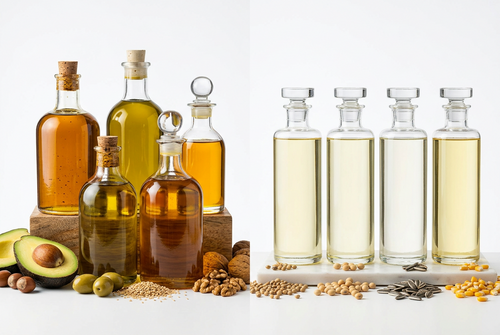
Natural, unprocessed oils
After extraction, natural, unprocessed oils are only filtered. As a result, many of the minor lipid constituents contained in the raw material are largely retained.
Depending on the oil, natural constituents may show up as a slight cloudiness, for example, or settle at the bottom of the container during storage. In natural, unprocessed grades, this is generally not an indication of a quality defect.
Our natural, unprocessed oils are obtained in particular by cold pressing or CO₂ extraction.

Cold-pressed oils
Cold-pressed oils are oils obtained by mechanical pressing without the deliberate application of external heat and subsequently filtered.
No chemical refining or steam deodorisation takes place. Characteristic colour, odour and flavour compounds of the raw material are therefore retained to a greater extent than in further processed oil grades.
However, the term ‘cold-pressed’ does not directly indicate the temperature actually reached during pressing. This can be influenced by factors such as pressure and friction.
Depending on the plant species, cold-pressed oils differ in stability and should be stored and processed according to their individual properties.

CO₂-extracted oils
In CO₂ extraction, carbon dioxide is brought into a supercritical state under increased pressure. In this state, it has special solvent properties and can be used to extract lipophilic constituents from plant-based raw materials.
The process allows controlled extraction at comparatively moderate temperatures and is therefore also suitable for sensitive raw materials.
Once the process is complete, the carbon dioxide is removed entirely. With proper process control, no residues of the extraction agent therefore remain in the oil obtained.

Post-treated oils
Depending on the application, it can make sense to specifically reduce certain natural minor constituents of a plant oil.
This applies, for example, to intense odour and flavour notes, certain colourants or other constituents that are undesirable in the respective formulation.
The most important post-treated oil grades include deodorised and refined oils.

Deodorised oils
Deodorisation is a physical processing step in which the oil is treated with steam under vacuum.
This reduces volatile odour and flavour compounds in particular. The resulting oil therefore has a considerably more neutral odour and taste.
Deodorised oils are particularly suitable for applications in which the plant oil’s own characteristics should have as little influence as possible on the finished formulation.

Refined oils
During refining, various undesirable minor constituents of the crude oil are reduced or removed. The aim is an oil grade that is as reproducible as possible and suitable for the respective application.
Refined oils are generally considerably more neutral in odour and taste than natural, unprocessed variants and can also offer advantages in terms of colour, stability and processing properties.
They are therefore suitable, among other things, for cosmetic formulations and food applications in which a neutral raw material character is desired.
For organic grades, only processes and processing aids that comply with the applicable legal requirements are used.

Macerates – traditional infused oils
Macerates are plant-based infused oils in which flowers, herbs, roots or other plant parts are steeped in a suitable plant-based carrier oil for a defined period.
During maceration, the carrier oil takes up lipophilic plant constituents in particular, as well as other characteristic minor constituents of the raw material used.
The result is versatile plant oils for cosmetic formulations – from classic European plants such as calendula, arnica and St John’s wort to traditionally used raw materials such as amla and ashwagandha.

Controlled maceration
For production, selected plant parts are placed in a suitable carrier oil and steeped for a defined period.
Depending on the plant species, dried or fresh raw materials can be used. Calendula and arnica flowers, for example, are often processed in dried form, while St John’s wort can also be macerated as fresh plant material.
During this time, oil-soluble plant constituents pass into the carrier oil. Depending on the raw material, these may include carotenoids and other natural minor constituents, for example.
Once maceration is complete, the infused oil is filtered to remove remaining plant parts and to obtain a well-processable, defined oil grade.

A wide variety of plant-based raw materials
Our range of macerates includes various plants and traditionally used raw materials, for example:
- Calendula macerate
- Arnica macerate
- St John’s wort macerate
- Carrot macerate
- Amla macerate
- Ashwagandha root macerate
- Aloe vera macerate
The exact composition, the carrier oil used and the respective INCI name may differ depending on the product. You will find the relevant details on the respective product page.
Important for formulation: The properties of a macerate are influenced by the plant raw material used as well as by the carrier oil and the manufacturing conditions.

Winterised oils
Winterisation is a physical process that can be used for both natural, unprocessed and further processed plant oils.
The oil is cooled to a low temperature in a controlled manner. Constituents with a higher melting point – in particular certain waxes – crystallise out.
These constituents can then be removed by filtration. This improves the clarity of the oil, especially at lower temperatures.

The application decides
Which oil grade is best suited to a formulation does not depend on the starting raw material alone.
Colour, inherent odour, oxidative stability, fatty acid profile, natural minor constituents, processing properties and the requirements of the end product also play an important role.
Natural or further processed? There is no single oil grade that is better across the board. What matters is which properties are needed for the respective application.
Which oil grade is right for your application?
We will be glad to advise you on choosing the right plant oil, the appropriate grade and the most suitable processing method for your formulation.